Madeira’s Ancient Fanal Forest Filled With 500-Year-Old Trees
EC Talks
April 29, 2020
environment
,
Fanal
,
forest
,
interesting facts
,
Madeira
,
Nature
,
park
,
the Azores
,
the Canary Islands
,
trees
This is going to be a very interesting article. Believe me once you start reading it and viewing the photographs of this forest. You will feel like you are entering a fairyland. Let's start.
FANAL LAURISILVA FOREST

The Laurisilva of
Madeira, within the Parque Natural da Madeira (Madeira Natural Park) conserves
the largest surviving area of primary laurel forest or "laurisilva",
a vegetation type that is now confined to the Azores, Madeira and the Canary Islands.
These forests display a wealth of ecological niches, intact ecosystem
processes, and play a predominant role in maintaining the hydrological balance
on the Island of Madeira. The property has great importance for biodiversity
conservation with at least 76 vascular plant species endemic to Madeira
occurring in the property, together with a high number of endemic invertebrates
and two endemic birds including the emblematic Madeiran Laurel Pigeon.
The Laurisilva of
Madeira is an outstanding relict of a previously widespread laurel forest type,
which covered much of Southern Europe 15-40 million years ago. The forest of
the property completely covers a series of very steep, V-shaped valleys leading
from the plateau and east-west ridge in the centre of the island to the north
coast. The forests of the property and their associated biological and
ecological process are largely undisturbed, and play a predominant role in the
island´s hydrological balance. The forest is mainly comprised of
evergreen trees and bushes, with flat, dark green leaves. The property provides
a wealth of ecological niches, complex food webs and examples of co-evolution
of species. A range of climax vegetation communities such as the "Til
Laurisilva", the "Barbusano Laurisilva" and the "Vinhático
Laurisilva", have been identified within the property. Ancient trees in
the valley bottoms, waterfalls and cliffs add to the experience of the values
of the property.
The Laurisilva of Madeira
is a place of importance for its biological diversity. A large proportion
of its plants and animals are unique to the laurel forest, and it is larger
than and with significant differences to other laurel forest areas. Endemic
trees belonging to the Lauraceae family such as the Barbusano Apollonias
barbujana ssp. Barbujana, the Laurel Laurus novocanariensis, the Til Ocotea
foetens and the Vinhático Persea indica are dominant. Other endemic plants
include plants such as Pride of Madeira Echium candicans, Honey Spurge
Euphorbia mellifera, Madeira Foxglove Isoplexis spectrum and Musschia
wollastonii. Ferns abound in the shadowy valleys and bryophytes cover large
areas of the soil, banks, rocks and tree trunks. Around 13 liverwort species
and 20 moss species are noted as threatened at a European scale, while abundant
lichens are indicative of high environmental quality and the absence of
pollution. Vertebrate species include a limited number of species with high
endemism, including two rare species of bats, the Madeira Pipistrelle
Pipistrellus maderensis and the Leisler's Bat Nyctalus leisleri verrucosus and
several birds, such as the Madeira Laurel Pigeon Columba trocaz, the Madeiran
Firecrest Regulus madeirensis and the Madeiran Chaffinch Fingilla coelebs madeirensis.
In the Laurisilva there are more than 500 endemic species of invertebrates,
including insects, arachnids and mollusks.

INTEGRITY
The property includes
the areas of primary laurisilva remaining on Madeira. Its boundaries were
defined after an exhaustive field study to identify the most significant areas
of remaining vegetation. Most of the property is believed to have never been
felled and includes some massive old trees, possibly over 800 years old, which
have been growing since before the island was settled. Goats and sheep,
which caused some damage in the past, have now been eradicated from the
area.
The property also
contains an important testimony of human use. The settlers of Madeira
constructed water channels, known as levadas, which run through the forest
following the contours of the landscape, and clinging to the cliffs and
steep-sided valleys. Typically 80-150 cm wide and constructed of stone or more
recently concrete; they carry water from the forest to hydropower stations and
to the towns of the south, where they provide essential drinking water and
irrigation supplies. Along the levadas there are paths typically 1-2m wide,
which allow access to the otherwise almost impenetrable forest. The impact of
these features on the property is limited, and also has some benefit for
conservation, since they allow access to the forest on relatively flat paths
and cover only an infinitesimal area of land. None has been built for 70 years,
but the present ones are carefully maintained. Apart from the levadas,
and the occasional tiny hut used by those that maintain them, human development
within the property is very limited and there is no habitation, no buildings,
except the occasional tiny hut for those who maintain the levadas, and no
cultivated land. There are limited impacts from two roads, with plans to
replace one by a tunnel.
The integrity of the
property is further enhanced by buffer zones that are not part of the inscribed
property but protect it from threats originating from outside its boundaries.
Possibly threats arising from these areas include invasive species and species
introductions from both agriculture and forestry.

PROTECTION AND MANAGEMENT REQUIREMENTS
The property comprises
approximately 15,000 ha of land within the 27,000 ha of Parque Natural da Madeira
(Madeira Natural Park). It has strong and effective legal protection under
regional, national and European Law. These multiple layers of protection
include status as a special area of conservation under the Habitats Directive
of the European Union, which obliges the State Party to protect the area so
that both "Madeiran laurel forest" and 39 species of rare and threatened
plants and animals remain at, or are restored to, "favourable conservation
status". The property is also a Biogenetic Reserve of the Council of
Europe, and a Special Protection Area under the European Union Birds Directive.
The property is gazetted under Madeiran law, with around half of the area as a
Strict Reserve ("Reserva Integral") and the remainder as a Partial
Reserve ("Reserva Parcial").
Effective conservation
management is also in place. Conservation functions are devolved to regional
government in the form of the Governo da Região Autónoma da Madeira (Autonomous
Regional Government of Madeira). A management plan (Plano de Ordenamento
e Gestão da Floresta Laurisilva) is in place and has been approved by the
Regional Government. This is a powerful legal instrument which defines
strategies and objectives for the protection and enhancement of the property,
drawing the main guidelines for its management, conservation and
protection.
Adequate staff and
resources are in place and need to be maintained in the long term. There
are a number of issues requiring effective long-term management. These include
monitoring the potential threat to the property from invasive species including
species from former agricultural land at the lower edge of the property. A
small number of permits is issued to local people for limited collection common
tree heather in the higher zones. Although declining, this use needs to be
monitored and kept within levels that do no harm to the forest. Management of
the areas adjacent to the property needs to fully consider its Outstanding
Universal Value, particularly in relation to the potential for introduction of
alien invasive species. Facilities for visitors to the laurel forest are few
and visitor management will need to be prioritized as tourism trends change.
With sheer cliffs beside narrow levadas, great care is needed to both to
protect the forest and to provide for safe visitor access, especially in
relation to possible increases in visitor pressure. Strong policies are needed
to ensure there is no temptation to build inappropriate facilities for
visitors. Effective visitor interpretation and education programmes would also
be highly beneficial to the communication of the Outstanding Universal Value of
the property.
PHOTO GALLERY


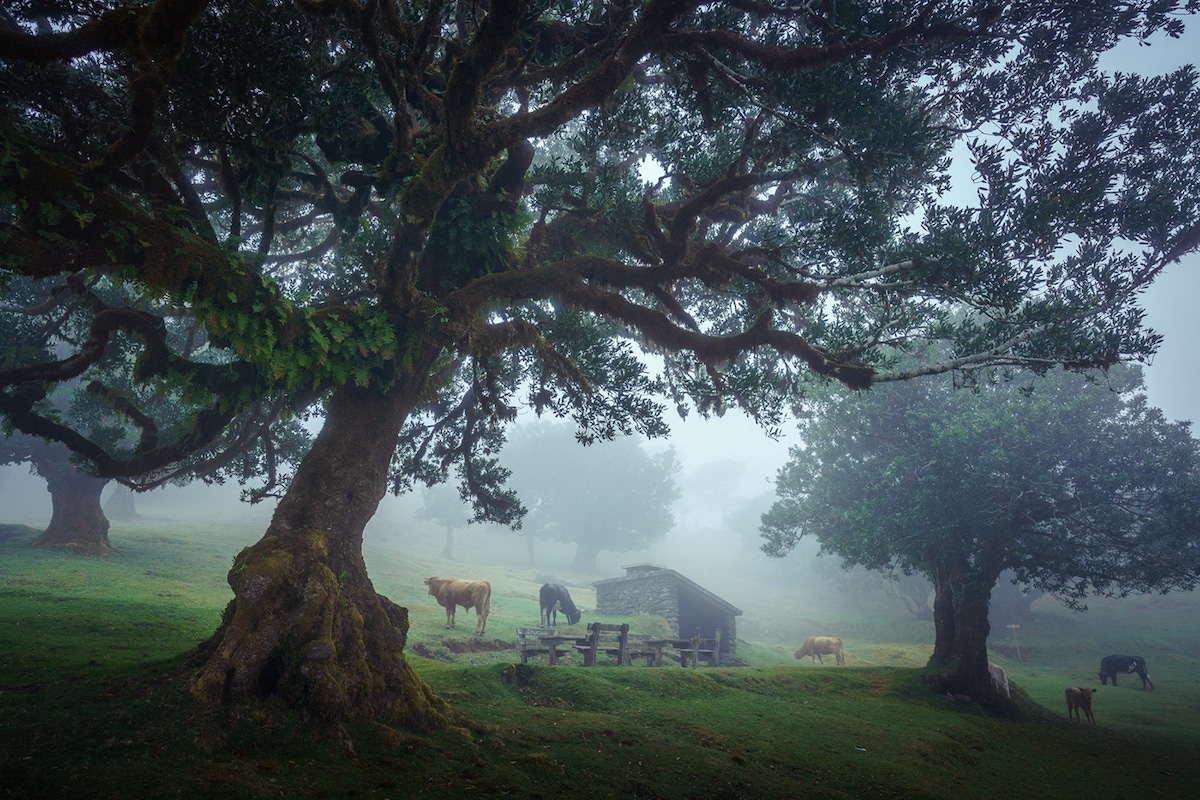


Photo credit: Albert Dros