Articles by "forest"
2020 agriculture air air pollution alien Amazing android animals apes app Archaeology Arctic circle ash dieback Atmosphere Attack Australia bacteria BBC beautiful beauty biodiversity biology Canada case studies causes chalk writing chernobyl disaster china climate climate change conservation conserve convenient coronavirus cosmic countries COVID 19 cryosphere cyclones difference earth earth day earth hazards EarthScience EC TALKS Ecology ecowatch Ecowatch education effects electric cars electricity endangered species energy engineers env issues env management env news environment Environmental Science evidence Evolution Evolutionary Biology ezymes facts Fanal fear fear of failure fires food forest forset fossil & ruins galaxies garbage global problem gorillas greece green revolution greenland Human Evolution hurricanes hydraulic press ice impacts Incredible industrial revolution information insects interesting facts invaders IPCC italy land land pollution landscapes light lockdown Locusts locusts v/s grasshopper loss Madeira mammals marine motivation mouse Mutation mystery nano scale NASA national geographic Nature Newyork Nitrogen dioxide NMR noise noise pollution ocean oceans oil spill old trees olive orangutans pacific Pakistan pandemic park peace petrochemicals photography Pink lakes planet plants plastic plastic pollution playstore poem pollution ponder protect Rachel Summer rain forest Ramadan kareem recycling renewable research researchers rodents Russia safe practices SAS satisfaction save science situation size social distancing Solar system solution solutions Soothing south korea stars statistics success symptoms technology the Azores the Canary Islands think tank treatment tree planting trees Turtles types UK UK govt ukraine UNESCO US virus water water pollution WHO wildfires wildlife William Wordsworth woodlands WWF Zoo zoology

Native woodlands can resist the spread of invasive species by blocking daylight reaching the forest floor, researchers have suggested.
They found the amount of light available in the spring and the autumn was "critical" for buckthorn, an alien invasive species in North America.
Invasive species dominate a local habitat and squeeze out native species and cost a vast sum to control.
The findings appear in the Forest Ecology and Management journal.
The team, comprising researchers from US and Australian universities, decided to focus its attention on common buckthorn (Rhamnus cathartica), which is an invasive shrub species in North America.
It out-competes native plants and degrades soils and forests, to the detriment of humans and other wildlife.

Uninvited guest

"In Minnesota alone, we spend millions of dollars each year managing buckthorn invasions and lose much more in the form of reduced forest quality," said co-author Michael Schuster from the Department of Forest Resources at the University of Minnesota.
Dr Schuster explained that in order to create environments that resist invasion by buckthorn, and thus avoid those costs and impacts of the natural capital, it was necessary to understand which forest characteristics offered the greatest influence on the success or failure of buckthorn plants becoming established.
"Canopy structure determines a lot about the conditions experienced by invading buckthorn, so we asked how changes in the composition of forest canopies might make those forests more or less vulnerable to buckthorn invasions," he told BBC News.

In their experiment, the team grew buckthorn seedlings under a variety of different canopies and measured the light available to the seedlings.
These included one made up from deciduous species, such as birch, another from evergreen species, such as pine, and another from a mixture of deciduous and evergreen species.
At the end of the three-year experiment, Dr Schuster observed: "Using these observations in combination with a statistical model of forest light availability, we showed that forests that are able to block out 96% of incoming light in the spring or autumn can successfully resist buckthorn invasion."
He added that, in general, evergreen species were much more capable of creating this level of shade compared with deciduous species.
"We anticipated that buckthorn would fail in areas with extremely low light levels, since having some light is necessary for [most] plants to live," he said.

Spring sunshine

Yet the team were surprised by how much the buckthorn seedlings depended upon light availability in the spring or autumn.
"Light availability in the spring and autumn was massively influential compared with mid-summer light," explained Dr Schuster.
"Whether a canopy produced a lot of shade in the summer or none at all, it really did not make much of a difference.
"For buckthorn, it was all about the spring and autumn."
Phenology - the study of the seasons, especially regarding how it affects wildlife, such as flowering and nesting/hatching times - has a long history stretching back to the 19th Century.
It is widely accepted that changes to the seasons affect the natural equilibrium in the natural world.
Dr Schuster and colleagues' study showed that there were "critical windows' of opportunity for buckthorn at the beginning and end of growing seasons.
"Certain forest types may be inherently vulnerable to invasion by buckthorn as a consequence of when they gain and lose their leaves," he said.
He added that if forest managers were seeking to improve the long-term resistance of their forests to buckthorn invasions then it might be necessary to introduce species that helped reduce the amount of light reaching the forest floor but historically were not present in the area, such as evergreens.
But this approach was not risk-free, warned Dr Schuster.
"For example, many oak forests in our region may simply lack the capacity to resist buckthorn - they leaf in late spring and create understories that do not get particularly dark," he observed.
But, he added: "If we change forests to have phenologies that exclude buckthorn, we may inadvertently push out some desirable native species at the same time.
"So, the question becomes whether we can curate plant communities to both have the species we want and also to produce ample shade in the spring and autumn to keep buckthorn out."
The team is currently investigating how to create dense shading in order to exclude buckthorn using a mixture of native plant species.
Success will help protect vulnerable native plants and animals in the future, and help curb the ever growing cost of tackling the relentless march of invasive species.
Source: By Mark Kinver, Environment reporter (BBC NEWS)

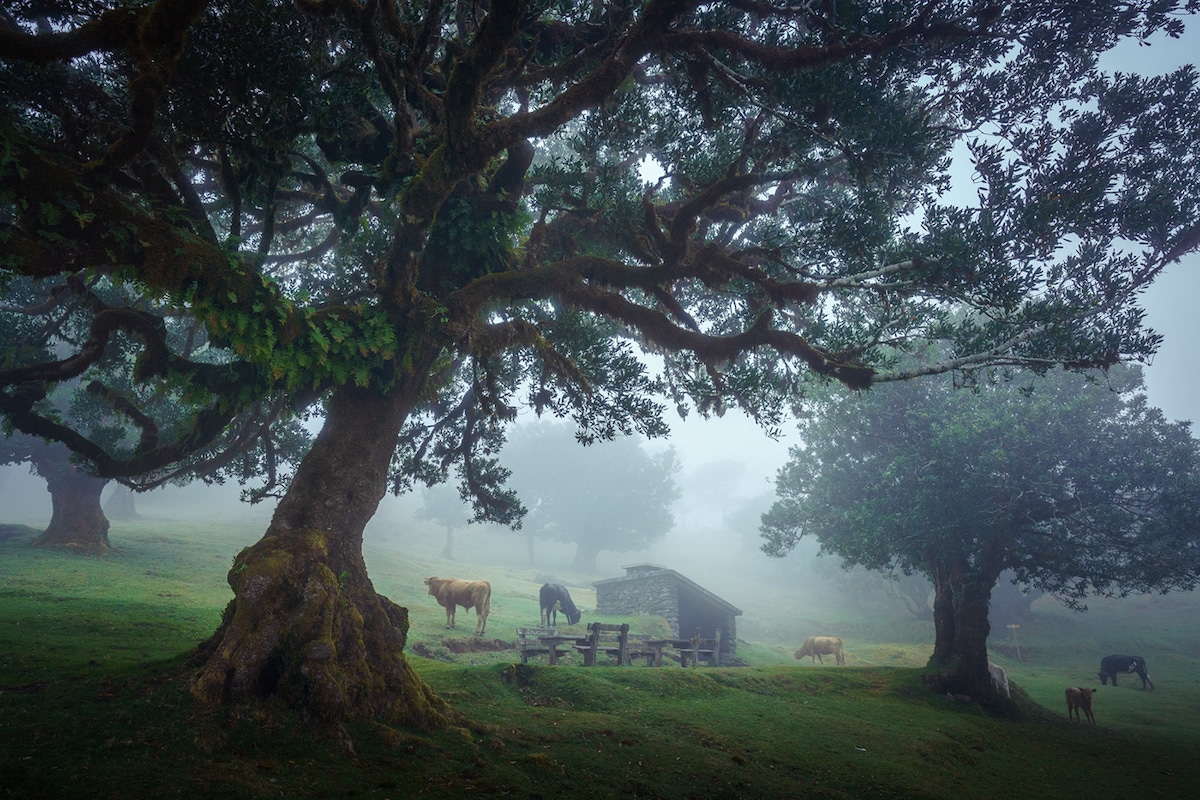
This is going to be a very interesting article. Believe me once you start reading it and viewing the photographs of this forest. You will feel like you are entering a fairyland. Let's start.

FANAL LAURISILVA FOREST


The Laurisilva of Madeira, within the Parque Natural da Madeira (Madeira Natural Park) conserves the largest surviving area of primary laurel forest or "laurisilva", a vegetation type that is now confined to the Azores, Madeira and the Canary Islands. These forests display a wealth of ecological niches, intact ecosystem processes, and play a predominant role in maintaining the hydrological balance on the Island of Madeira. The property has great importance for biodiversity conservation with at least 76 vascular plant species endemic to Madeira occurring in the property, together with a high number of endemic invertebrates and two endemic birds including the emblematic Madeiran Laurel Pigeon.

The Laurisilva of Madeira is an outstanding relict of a previously widespread laurel forest type, which covered much of Southern Europe 15-40 million years ago. The forest of the property completely covers a series of very steep, V-shaped valleys leading from the plateau and east-west ridge in the centre of the island to the north coast. The forests of the property and their associated biological and ecological process are largely undisturbed, and play a predominant role in the island´s hydrological balance.  The forest is mainly comprised of evergreen trees and bushes, with flat, dark green leaves. The property provides a wealth of ecological niches, complex food webs and examples of co-evolution of species. A range of climax vegetation communities such as the "Til Laurisilva", the "Barbusano Laurisilva" and the "Vinhático Laurisilva", have been identified within the property. Ancient trees in the valley bottoms, waterfalls and cliffs add to the experience of the values of the property.

The Laurisilva of Madeira is a place of importance for its biological diversity.  A large proportion of its plants and animals are unique to the laurel forest, and it is larger than and with significant differences to other laurel forest areas. Endemic trees belonging to the Lauraceae family such as the Barbusano Apollonias barbujana ssp. Barbujana, the Laurel Laurus novocanariensis, the Til Ocotea foetens and the Vinhático Persea indica are dominant. Other endemic plants include plants such as Pride of Madeira Echium candicans, Honey Spurge Euphorbia mellifera, Madeira Foxglove Isoplexis spectrum and Musschia wollastonii. Ferns abound in the shadowy valleys and bryophytes cover large areas of the soil, banks, rocks and tree trunks. Around 13 liverwort species and 20 moss species are noted as threatened at a European scale, while abundant lichens are indicative of high environmental quality and the absence of pollution. Vertebrate species include a limited number of species with high endemism, including two rare species of bats, the Madeira Pipistrelle Pipistrellus maderensis and the Leisler's Bat Nyctalus leisleri verrucosus and several birds, such as the Madeira Laurel Pigeon Columba trocaz, the Madeiran Firecrest Regulus madeirensis and the Madeiran Chaffinch Fingilla coelebs madeirensis. In the Laurisilva there are more than 500 endemic species of invertebrates, including insects, arachnids and mollusks.  

INTEGRITY

The property includes the areas of primary laurisilva remaining on Madeira.  Its boundaries were defined after an exhaustive field study to identify the most significant areas of remaining vegetation. Most of the property is believed to have never been felled and includes some massive old trees, possibly over 800 years old, which have been growing since before the island was settled.  Goats and sheep, which caused some damage in the past, have now been eradicated from the area. 

The property also contains an important testimony of human use. The settlers of Madeira constructed water channels, known as levadas, which run through the forest following the contours of the landscape, and clinging to the cliffs and steep-sided valleys. Typically 80-150 cm wide and constructed of stone or more recently concrete; they carry water from the forest to hydropower stations and to the towns of the south, where they provide essential drinking water and irrigation supplies. Along the levadas there are paths typically 1-2m wide, which allow access to the otherwise almost impenetrable forest. The impact of these features on the property is limited, and also has some benefit for conservation, since they allow access to the forest on relatively flat paths and cover only an infinitesimal area of land. None has been built for 70 years, but the present ones are carefully maintained.  Apart from the levadas, and the occasional tiny hut used by those that maintain them, human development within the property is very limited and there is no habitation, no buildings, except the occasional tiny hut for those who maintain the levadas, and no cultivated land.  There are limited impacts from two roads, with plans to replace one by a tunnel.


The integrity of the property is further enhanced by buffer zones that are not part of the inscribed property but protect it from threats originating from outside its boundaries. Possibly threats arising from these areas include invasive species and species introductions from both agriculture and forestry.


PROTECTION AND MANAGEMENT REQUIREMENTS

The property comprises approximately 15,000 ha of land within the 27,000 ha of Parque Natural da Madeira (Madeira Natural Park). It has strong and effective legal protection under regional, national and European Law. These multiple layers of protection include status as a special area of conservation under the Habitats Directive of the European Union, which obliges the State Party to protect the area so that both "Madeiran laurel forest" and 39 species of rare and threatened plants and animals remain at, or are restored to, "favourable conservation status".  The property is also a Biogenetic Reserve of the Council of Europe, and a Special Protection Area under the European Union Birds Directive. The property is gazetted under Madeiran law, with around half of the area as a Strict Reserve ("Reserva Integral") and the remainder as a Partial Reserve ("Reserva Parcial").

Effective conservation management is also in place. Conservation functions are devolved to regional government in the form of the Governo da Região Autónoma da Madeira (Autonomous Regional Government of Madeira).  A management plan (Plano de Ordenamento e Gestão da Floresta Laurisilva) is in place and has been approved by the Regional Government.  This is a powerful legal instrument which defines strategies and objectives for the protection and enhancement of the property, drawing the main guidelines for its management, conservation and protection. 

Adequate staff and resources are in place and need to be maintained in the long term.  There are a number of issues requiring effective long-term management. These include monitoring the potential threat to the property from invasive species including species from former agricultural land at the lower edge of the property. A small number of permits is issued to local people for limited collection common tree heather in the higher zones. Although declining, this use needs to be monitored and kept within levels that do no harm to the forest. Management of the areas adjacent to the property needs to fully consider its Outstanding Universal Value, particularly in relation to the potential for introduction of alien invasive species. Facilities for visitors to the laurel forest are few and visitor management will need to be prioritized as tourism trends change. With sheer cliffs beside narrow levadas, great care is needed to both to protect the forest and to provide for safe visitor access, especially in relation to possible increases in visitor pressure. Strong policies are needed to ensure there is no temptation to build inappropriate facilities for visitors. Effective visitor interpretation and education programmes would also be highly beneficial to the communication of the Outstanding Universal Value of the property. 

 PHOTO GALLERY


Photo credit: Albert Dros

Mass tree planting in the UK could harm the environment if not planned properly, a report warns.

Badly-planned trees would increase greenhouse gas emissions, say the government’s advisers on the economic value of the natural environment.
The report comes from the Natural Capital Committee (NCC), which says planting trees into peat bogs would prove a serious mistake.
Peat locks up vast quantities of carbon - but trees dry out peat.
This can release more greenhouse gases than the trees absorb.
One NCC member, Prof Ian Bateman from the University of Exeter, said: “The mantra has to be ‘the right tree in the right place’.“
“We would be crazy to undertake the massive scale of planting being considered if we did not also consider the wider effects upon the environment including impacts on wildlife, benefits in terms of reducing flood risks and effects on water quality, improvements to recreation and so on.”

Will millions more trees really stop climate change?

Right trees in right places
The report adds that carpeting upland pastures with trees would reduce the UK’s ability to produce meat – which may lead to increasing imports from places that produce beef by felling rain forests.
It also makes a similar point on industry. There’s no point closing dirty UK factories, the authors say, if we’re then going to import goods from places with worse emissions.
The authors note that huge publicity has been given to the UK’s plans for planting 11 million trees to lock up carbon emissions, but they warn that conserving carbon in soils is equally or more important.
The report points out that the Office for National Statistics (ONS) estimates that in 2007 UK soils contained approximately 4,019 million tonnes of carbon (MtC), that’s 94.2% of the total stock of biological carbon - excluding fossil fuel carbon.
They say soil degradation through erosion, intensive farming and development creates losses estimated at between £0.9 –1.4bn per year for England and Wales alone.

Soils underpin everything

Prof Kathy Willis from Oxford University and an NCC member, told BBC News: “We love looking at trees – we get all these positive emotions, smells and sounds – but most of us don't look at soil that actually underpins everything.”
The NCC calls for much better monitoring of soils. And it says that farming on lowland peat such as the rich fields of East Anglia should be halted if soil there continues to be lost.
This recommendation may be strongly resisted by farmers, although some of them say they’re addressing the problem by using “cover crops” to bind the soil together while cash crops are being planted.
The Country Land and Business Association have been approached to comment.
The NCC notes previous reports projecting a reduction in the consumption of amount of red meat and dairy produce by at least 20% per person and reducing food waste by 20%.
This implies around a 10% reduction in cattle and sheep numbers by 2050, compared with 2017 levels.
The report outlines the scale of the challenge for measures taken to tackle climate change through land use policies in the UK.
It says: “These figures make it clear that – far from being an option for major offsetting of emissions from other sectors – the measures will not even mitigate the emissions of the agriculture, land use and peat lands sectors."
Source: By Roger Harrabin (BBC)

MKRdezign

Contact Form

Name

Email *

Message *

Powered by Blogger.
Javascript DisablePlease Enable Javascript To See All Widget