Articles by "causes"
2020 agriculture air air pollution alien Amazing android animals apes app Archaeology Arctic circle ash dieback Atmosphere Attack Australia bacteria BBC beautiful beauty biodiversity biology Canada case studies causes chalk writing chernobyl disaster china climate climate change conservation conserve convenient coronavirus cosmic countries COVID 19 cryosphere cyclones difference earth earth day earth hazards EarthScience EC TALKS Ecology ecowatch Ecowatch education effects electric cars electricity endangered species energy engineers env issues env management env news environment Environmental Science evidence Evolution Evolutionary Biology ezymes facts Fanal fear fear of failure fires food forest forset fossil & ruins galaxies garbage global problem gorillas greece green revolution greenland Human Evolution hurricanes hydraulic press ice impacts Incredible industrial revolution information insects interesting facts invaders IPCC italy land land pollution landscapes light lockdown Locusts locusts v/s grasshopper loss Madeira mammals marine motivation mouse Mutation mystery nano scale NASA national geographic Nature Newyork Nitrogen dioxide NMR noise noise pollution ocean oceans oil spill old trees olive orangutans pacific Pakistan pandemic park peace petrochemicals photography Pink lakes planet plants plastic plastic pollution playstore poem pollution ponder protect Rachel Summer rain forest Ramadan kareem recycling renewable research researchers rodents Russia safe practices SAS satisfaction save science situation size social distancing Solar system solution solutions Soothing south korea stars statistics success symptoms technology the Azores the Canary Islands think tank treatment tree planting trees Turtles types UK UK govt ukraine UNESCO US virus water water pollution WHO wildfires wildlife William Wordsworth woodlands WWF Zoo zoology


HELLO WORLD!

Here is your blogger again with a new and interesting article. Besides being interesting and new, this article is very important. As the title indicates, yes you have guessed it right. Today, we will talk about failure and all the fears related to it. So let’s begin!

Basically, what is failure?

“Failure is the state or condition of not meeting a desirable or intended objective, and may be viewed as the opposite of success.”
Failure is when you are unable to achieve your intended goal that you might have planned as your future goals. And no doubt may be you have done a whole lot of hard work to pursue your goals. But you couldn’t. Why that’s another long debate. Hold on don’t worry we will talk about it as well but some other day.

Let’s start this important topic!

Atychiphobia is basically the fear of failure. It’s a state when one allows one’s fear to stop him/her from achieving his/her goals. This fear never ever in your life let you do anything productive. Rather takes you towards depression, anxiety, irrational state and disturbed and jumbled up mindset.

SYMPTOMS

Everyone in their life at some extent does have or had a fear of failure. If not always it can be just at some points. You may experience some or all of these symptoms if you fear of failure;
  • Hesitation to try out new things or to get involved in challenging situations
  • Self-sabotage – for example procrastination, excessive, or a failure to follow through with goals.
  • Low confidence or self-esteem- as you think negatively about yourself that you will not be able to achieve your desired goal or it will not end in the way I have planned.
  • Reluctance to go through trial and error phase.
  • Perfectionism- a willingness to try only those things that you might end perfectly and you are already an expert in it.
  • You don’t want to do adventure in your life.
CAUSES
To talk about causes, we all need to know a clear definition of failure. We all might have our own definition of failure. Failure has a broad spectrum of definitions, depending upon everyone’s perspective. Failure to one person might be a great learning experience for another person. So it all depends upon your views and ideas. The following are the causes of failure according to my perspective;
  • Unsupportive parents can be the cause of your failure.
  • Pressure of responsibilities might be the cause of failure. Because when you have responsibilities then you try to do the things in which you are already an expert. That’s due to the fact that you don’t wants to take risk for your family.
  • Our number one cause of fear of failure can be due to our prioritization of this society. We have made society so big deal that we can’t think now likes an individual. Instead we think in terms of society, that if we will do this what will happen and if I/we  got failure then hat society will thing about me/us.
  • Negative people are also a big cause of your fear of failure. These people will never let you succeed. Because they will continue to criticize you. They will degrade you in every situation.
  • Or sometimes lack of guidance or information can be the cause of fear of failure. Because you might be the eldest one in your family and home. That’s why you are already stressed about the fact that as per our society if you are the eldest one so you will set an example whether good or bad.
  • Situation can be opposite, you might be the youngest one or the mid one and you have to follow the examples set by the elders. This can also be a huge pressure on you and can lead you towards hesitancy to try it.  

SOLUTION

Here are some important steps that you all must follow if you really want to get rid of your fear of failure;
  • Self-realization of the fact that if you are starting something then it can end up with success as well as failure. Because this is the same case like the two sides of coin, there are also two possibilities.
  • Avoid negative people- because they will never let you overcome your fear.
  • Stay positive- always think positive and stay with positive people. Because a person is always identified from his/her company/ companions.
  • Let society think whatever they want to.
  • Do whatever you want to do without following anyone else’s ideas.
  • Analyze all the potential outcomes- this will also help you to overcome your failure as you have the fear of unknown. So, when you will analyze the outcomes then there will be no reason to be afraid of.
  • Think strategically- that if this plan (plan A) will fail then you can execute your plan B or C. In this way you will never be afraid of failure because you will already have backup plans.
  • Always start from small steps- instead of taking a big step and facing failure. Plan to achieve your goals and manage your plan strategically. Always start step by step and start your journey towards the achievement of your ultimate goal by taking small steps.
  • Practice trial and error- life is full of trials and errors phases. Try new things and explore new opportunities and new experiences.
  • Take risk.
  • Take everything as an opportunity.
These are all the steps that will help to improve your personalities as well. But these are all the things that are useless until or unless we really practice it in real. And only You, We and I can do it, keep remember no one else is going to come and help us. So start loving yourself.

Keep in mind!

You are beautiful from inside and out. You can do it. Because you the most super talented person in this World!

GLOSSARY

  • Self-sabotage is when we actively or passively take steps to prevent ourselves from reaching our goals.
  • Procrastination is the action of delaying or postponing something.

NOTE
The purpose of this article is to draw attention to this side that hinders your way towards the success. I hope this article really motivated you and helped you to overcome your fear or at least you start thinking to try it.
-       ­BY NAINA SYED (YOUR BLOGGER)

Air pollution, release into the atmosphere of various gases, finely divided solids, or finely dispersed liquid aerosols at rates that exceed the natural capacity of the environment to dissipate and dilute or absorb them. These substances may reach concentrations in the air that cause undesirable health, economic, or aesthetic effects. 


It occurs when any harmful gases, dust, smoke enters into the atmosphere and makes it difficult for plants, animals, and humans to survive as the air becomes dirty. 
Air pollution can further be classified into two sections- visible air pollution and invisible air pollution. Another way of looking at air pollution could be any substance that holds the potential to hinder the atmosphere or the well-being of the living beings surviving in it. The sustainment of all things living is due to a combination of gases that collectively form the atmosphere; the imbalance caused by the increase or decrease in the percentage of these gases can be harmful to survival. 

Types of Pollutants

In order to understand the causes of Air pollution, several divisions can be made. 
  • Primary air pollutants can be caused by primary sources or secondary sources. The pollutants that are a direct result of the process can be called primary pollutants. A classic example of a primary pollutant would be the sulfur-dioxide emitted from factories 
  • Secondary pollutants are the ones that are caused by the intermingling and reactions of primary pollutants. Smog created by the interactions of several primary pollutants is known to be as a secondary pollutant. 

 Sources of Air pollution

There are two types of sources i.e. Natural sources and Man-made sources;
  • Natural sources of pollution include dust carried by the wind from locations with very little or no green cover, gases released from the body processes of living beings (Carbon dioxide from humans during respiration, Methane from cattle during digestion, Oxygen from plants during Photosynthesis). Smoke from the combustion of various inflammable objects, volcanic eruptions, etc along with the emission of polluted gases also makes it to the list of natural sources of pollution.
  • Man-made contributions towards air pollution, smoke again features as a prominent component. The smoke emitted from various forms of combustion like in biomass, factories, vehicles, furnaces, etc. Waste used to create landfills generates methane, which is harmful in several ways. The reactions of certain gases and chemicals also form harmful fumes that can be dangerous to the well-being of living creatures. 

Major Air pollutants 

Air pollution is a real public health and environmental problem that can lead to-among other things-global warming, acid rain, and the deterioration of the ozone layer. Some common pollutants are;

  1. Ozone: A gas that can be found in two places. Near the ground (the troposphere), it is a major part of smog. The harmful ozone in the lower atmosphere should not be confused with the protective layer of ozone in the upper atmosphere (stratosphere), which screens out harmful ultraviolet rays.
  2. Carbon monoxide: A gas that comes from the burning of fossil fuels, mostly in cars. It cannot be seen or smelled.
  3. Nitrogen dioxide: A reddish brown gas that comes from the burning of fossil fuels. It has a strong smell at high levels
  4. Particulate matter: Solid or liquid matter that is suspended in the air. To remain in the air, particles usually must be less than 0.1-mm wide and can be as small as 0.00005 mm.
  5. Sulfur dioxide: A corrosive gas that cannot be seen or smelled at low levels but can have a ―rotten egg smell at high levels.
  6. Lead: A blue-gray metal that is very toxic and is found in a number of forms and locations.
  7. Toxic air pollutants: A large number of chemicals that are known or suspected to cause cancer. Some important pollutants in this category include arsenic, asbestos, benzene, and dioxin.
  8. Stratospheric ozone depleters: Chemicals that can destroy the ozone in the stratosphere. These chemicals include chlorofluorocarbons (CFCs), halons, and other compounds that include chlorine or bromine.
  9. Greenhouse gases: Gases that stay in the air for a long time and warm up the planet by trapping sunlight. This is called the ―greenhouse effect because the gases act like the glass in a greenhouse. Some of the important greenhouse gases are carbon dioxide, methane, and nitrous oxide. 
Source: Jonathan Levy, Harvard School of Public Health. Based on information provided by the Environmental Protection Agency.

Causes of Air pollution

 1. The burning of fossil fuels 

Sulfur dioxide emitted from the combustion of fossil fuels like coal, petroleum and other factory combustibles are one the major cause of air pollution. Pollution emitting from vehicles including trucks, jeeps, cars, trains, airplanes cause an immense amount of pollution. We rely on them to fulfill our daily basic needs of transportation. But, their overuse is killing our environment as dangerous gases are polluting the environment. Carbon Monoxide caused by improper or incomplete combustion and generally emitted from vehicles is another major pollutant along with Nitrogen Oxides, which is produced from both natural and man-made processes. 

2. Agricultural activities 

Ammonia is a very common byproduct from agriculture-related activities and is one of the most hazardous gases in the atmosphere. Use of insecticides, pesticides, and fertilizers in agricultural activities has grown quite a lot. They emit harmful chemicals into the air and can also cause water pollution. 

3. Exhaust from factories and industries 

Manufacturing industries release a large amount of carbon monoxide, hydrocarbons, organic compounds and chemicals into the air thereby depleting the quality of air. Manufacturing industries can be found at every corner of the earth and there is no area that has not been affected by it. Petroleum refineries also release hydrocarbons and various other chemicals that pollute the air and also cause land pollution. 

4. Mining operations 

Mining is a process wherein minerals below the earth are extracted using large equipment. During the process dust and chemicals are released in the air causing massive air pollution. This is one of the reasons which are responsible for the deteriorating health conditions of workers and nearby residents. 

5. Indoor air pollution 

Household cleaning products, painting supplies emit toxic chemicals in the air and cause air pollution. Suspended particulate matter (SPM) is another cause of pollution. Referring to the particles afloat in the air, SPM is usually caused by dust, combustion, etc. 

 Effects of Air pollution

1. Respiratory and heart problems 

The effects of air pollution are alarming. They are known to create several respiratory and heart conditions along with Cancer, among other threats to the body. Several million are known to have died due to direct or indirect effects of Air pollution. Children in areas exposed to air pollutants are said to commonly suffer from pneumonia and asthma. 

2. Global warming 

Another direct effect is the immediate alterations that the world is witnessing due to global warming. With increased temperatures worldwide, increase in sea levels and melting of ice from colder regions and icebergs, displacement and loss of habitat have already signaled an impending disaster if actions for preservation and normalization aren't undertaken soon. 

3. Acid rain

Harmful gases like nitrogen oxides and sulfur oxides are released into the atmosphere during the burning of fossil fuels. When it rains, the water droplets combine with these air pollutants becomes acidic and then falls on the ground in the form of acid rain. Acid rain can cause great damage to human, animals, and crops. 

4. Eutrophication 

Eutrophication is a condition where a high amount of nitrogen present in some pollutants, gets developed on sea‘s surface and turns itself into algae and adversely affect fish, plants and animal species. The green colored algae that are present on lakes and ponds are due to the presence of this chemical only. 

5. Effect on wildlife 

Just like humans, animals also face some devastating effects of air pollution. Toxic chemicals present in the air can force wildlife species to move to a new place and change their habitat. The toxic pollutants deposit over the surface of the water and can also affect sea animals. 

6. Depletion of the ozone layer 

Ozone exists in the Earth‘s stratosphere and is responsible for protecting humans from harmful ultraviolet (UV) rays. Earth‘s ozone layer is depleting due to the presence of chlorofluorocarbons, hydro chlorofluorocarbons in the atmosphere. As the ozone layer will go thin, it will emit harmful rays back on earth and can cause skin and eye related problems. UV rays also have the capability to affect crops.

 Solutions For Air Pollution 

1. Use public mode of transportation 

Encourage people to use more and more public modes of transportation to reduce pollution. Also, try to make use of carpooling. If you and your colleagues come from the same locality and have same timings you can explore this option to save energy and money. 

2. Conserve energy 

Switch off fans and lights when you are going out. A large number of fossil fuels are burnt to produce electricity. You can save the environment from degradation by reducing the number of fossil fuels to be burned. 

3. Understand the concept of Reduce, Reuse and Recycle 

Do not throw away items that are of no use to you. In-fact reuses them for some other purpose. For e.g. you can use old jars to store cereals or pulses. 

4. Emphasis on clean energy resources

Clean energy technologies like solar, wind and geothermal are on high these days. Governments of various countries have been providing grants to consumers who are interested in installing solar panels for their home. This will go a long way to curb air pollution. 

5. Use energy efficient devices 

CFL lights consume less electricity as against their counterparts. They live longer, consume less electricity, lower electricity bills and also help you to reduce pollution by consuming less energy.

 Air pollution: a global problem

Air pollution is a major global environmental risk to our health and food security. It is estimated to cause about 3.7 million premature deaths worldwide and destroys enough crops to feed millions of people every year. Health officials, the general public and farmers need advance notice when dangerous air quality levels are on the rise. 
Researchers and engineers at the National Center for Atmospheric Research (NCAR), in collaboration with other agencies, are dedicated to developing new technologies that directly help decision-makers plan for high-pollution days. Air pollution kills an estimated seven million people worldwide every year. WHO data shows that 9 out of 10 people breathe air containing high levels of pollutants. WHO (World Health Organization) is working with countries to monitor air pollution and improve air quality. From smog hanging over cities to smoke inside the home, air pollution poses a major threat to health and climate. The combined effects of ambient (outdoor) and household air pollution cause about seven million premature deaths every year, largely as a result of increased mortality from stroke, heart disease, chronic obstructive pulmonary disease, lung cancer and acute respiratory infections. More than 80% of people living in urban areas that monitor air pollution are exposed to air quality levels that exceed WHO guideline limits, with low- and middle-income countries suffering from the highest exposures, both indoors and outdoors.


How many marine animals die each year from pollution and plastic? 

  • 100 million marine animals die each year from plastic waste alone. 
  • 100,000 marine animals die from getting entangled in plastic yearly – this is just the creatures we find! 
  • 1 in 3 marine mammal species get found entangled in litter, 12-14,000 tons of plastic are ingested by North Pacific fish yearly. 
  • Our marine pollution and debris are hazardous for creatures in the gyres. 
  • Loggerhead sea turtles hunt jellyfish, which unfortunately look remarkably like plastic bags.  
  • The majority of marine life cannot differentiate their food from plastic garbage we’ve dumped. 
  • These animals starve to death, clogging their stomachs with plastic so they can’t eat real food. 
  • For example, Albatrosses and other birds mistake plastics for fish eggs, and they sadly feed them to their chicks, which in turn perish from organ failure or starvation. 
  • Marine plastic pollution is found in 100% of turtles, 59% of whales, and 36% of seals in recent studies. 
  • The air isn’t safe either,more than 90% of all seabirds are found to have plastic pieces in their stomachs. 
  • Mammals like seals drown in the 705,000 tons of discarded fishing nets – this horrifying phenomenon has been dubbed ‘ghost fishing’. 
  • 500 marine locations are now recorded as dead zones globally, currently the size of the United Kingdom’s surface (245,000 km²) 
  • Our coral reefs house some 25% of all marine life known to man. 
  • When it comes in contact with marine plastic, the probability of it dying goes from 4%-89%. 
  • The majority of fish we consume as humans (trout, perch, cisco, etc) would have ingested plastic and microfibers. 

It was believed that due to the vast size of the ocean, we could dump waste and it would not have any impact, however the increase of volumes coupled with the way the gyres and current take move them, this is not the case. How many marine animals die each year from plastic… 100 million is the current estimated figure, and this includes fish, mammals and sea birds.   
When looking at animals affected by water pollution, globally, it’s estimated that 50% of sea turtles are impacted by plastics, ingesting it and dying through their digestive systems getting clogged. For many turtles, jellyfish are a crucial part of their diets, and it just so happened that plastic bags look a lot like them.   
There are 705,000 tons of discarded fishing nets in the ocean, too, and this is another critical threat to many sea mammals like seals, dolphins, whales, and even smaller animals such as fish and sea lions. Getting tangled in these can lead to injury and often death.   
As far as sea birds are concerned, the figures are shocking. Of all species studied, 98% of Albatross are believed to have ingested plastics at some point. This is due to them mistaking the microplastics for fish eggs, passing them to their young as well as consuming them as adults.   
 Fish are absorbing toxins from the ocean and are taking in debris through their gills. Whales take in vast amounts of plastics and waste mistaking it for food, examinations of stranding’s have shown increases in this issue.   
Where we can see waste debris is a huge problem, marine animals are harmed by toxic chemicals like oil and other pollutants are entering the ocean through spills and drainage. This vastly alters the ecosystem and suffocates any marine life coming into contact. 
Sources: OceanCrusaders, PlasticOceans, National Geographic, UNESCO, EarthDay, SAS 

TYPES OF MARINE POLLUTION: FACTS AND STATISTICS 


There are five types of marine pollution: 
Pollutant 1: Ocean Acidification 
The oceans that cover our planet act as a carbon dioxide sponge; when it’s in our atmosphere it gets absorbed by our oceans. The positive effect of this is that our oceans are lowering our global warming by reducing CO2 concentration. The problem is the levels of CO2 are too high and the volume getting absorbed by the sea is impacting pH levels. This is extremely harmful as it changes the whole ecosystem, vulnerable habitats like coral fall victim to this, which are home to 25% of all marine life. 
Pollutant 2: Plastic Debris 
There are 5.25 trillion pieces of plastic estimated to be in our oceans, and this plastic waste is a violent threat to all marine life. Discarded fishing nets get all sorts of creatures tangled in them, fish, turtles, and seabirds eat microplastics mistaken for food. Every year the ingestion of these products leads to a long-winded and horrible death to millions of animals. Furthermore, many of these animals consuming plastics are actually in our food chain, so our waste comes back to poison us too. 
Pollutant 3: Eutrophication 
Eutrophication is a process when the water body has an increase in chemical nutrient concentration. This can spike the growth of plants or, more often than not, where pollution is concerned, cause mass decay, reducing oxygen levels in the water. This results in ‘dead zones’ where the oxygen levels are so low that marine life cannot survive. 
Pollutant 4: Noise 
Human activities can generate a lot of noise within the oceans from sources such as seismic surveys, oil exploration, sonar, and mass cargo shipping. Many forms of marine life depend on their sense of hearing for survival; for example the confusion from the Navy’s sonar has been linked to whale stranding. 
Pollutant 5: Toxins 
Toxins such as DDT, heavy metals, pesticides, phenols, PCBs, etc. are what are called persistent toxins – What are the effects of marine pollution with toxins? they do not disintegrate in our oceans. These toxins enter the bodies of all forms of the marine life food chain and ultimately end up causing disease and death. Of course, we are within this food chain as the apex predator, meaning we are also consuming these biomagnified toxins from our food.
Sources: EcoWatch, BBC, RubiconGlobal, NBC, PlasticOceans1, PlasticOceans2, OceanCrusaders, VOX 

What are the causes of marine pollution? 

  • 80% of pollution in our oceans comes from land-based sources. 
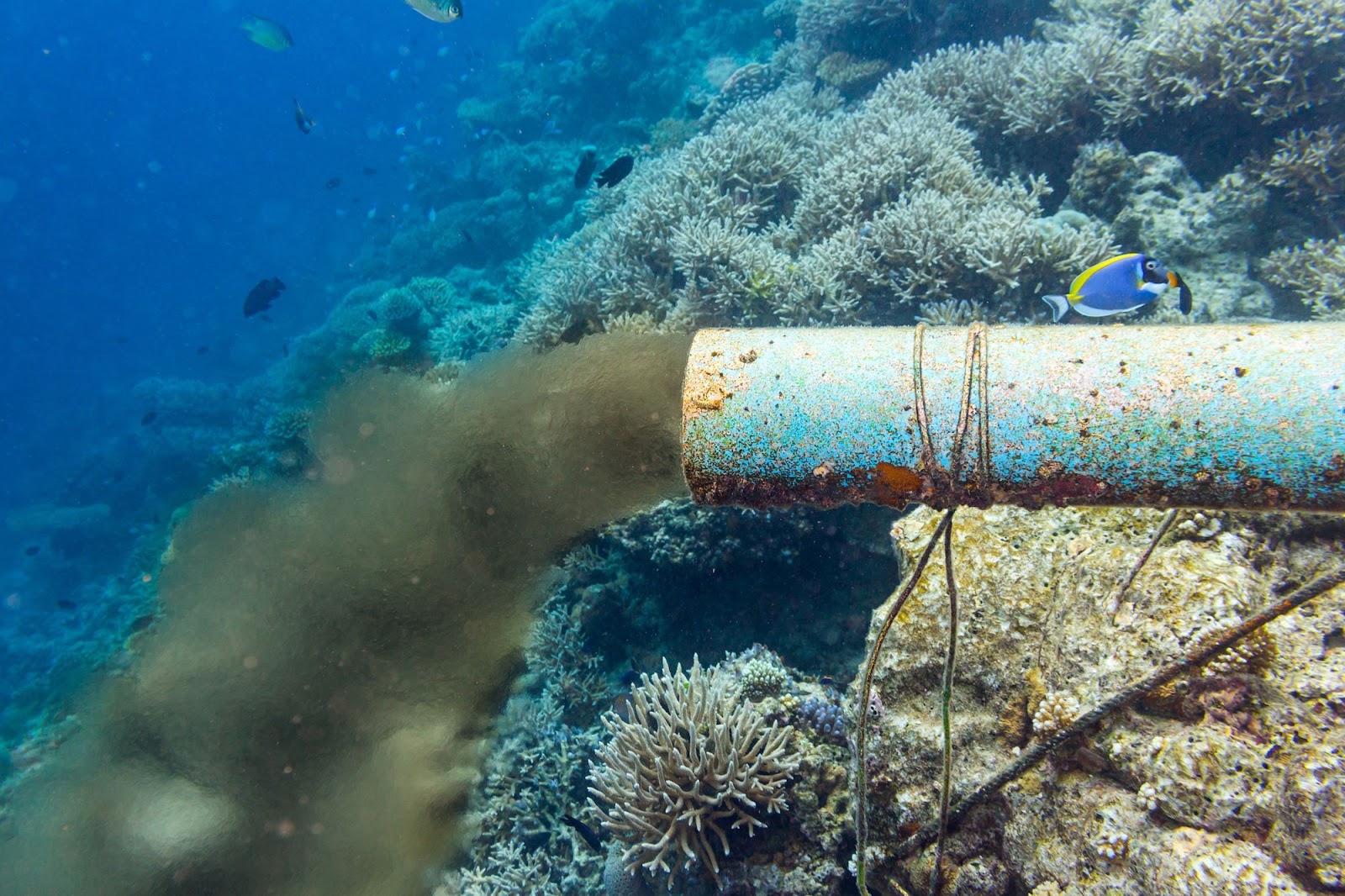
  • Most developing countries dispose of 90% water, and 70% industrial waste gets discharged into our oceans without treatment. 
  • We produce 100,000 chemicals commercially – all of which threaten the ocean through transport accidents and leaking into the soil or atmosphere to reach the sea. 
  • 1950-1998 over 100 nuclear blast tests occurred in our oceans. 
  • 50% of the world’s ship cargo is considered dangerous to the environment; 90% of the planets international trade is transported by ship. 6,000 offshore gas and oil installations provide 30% of the world's energy supply. 
  • The gas and oil industry releases greenhouse gases and causes thousands of spills annually. Oil spills are vastly dangerous to the oceans, but only 12% come from actual spills – the rest leaks in from drains and rivers. 
  • 3,000 different marine species are transported around the planet in 12 Billion tons of ballast waters, causing significant problems with invasive species entering marine ecosystems. In the Baltic sea alone, there are over 100 alien species impacting marine life. 
  • 80% of global marine pollution comes from agriculture runoff, untreated sewage, discharge of nutrients and pesticides. 
  • Coastal areas get significantly impacted by fertilizer runoff from lawns and farms. These nutrients cause algal blooms to flourish and dissolve the water's oxygen levels. These harmful algal-based blooms have tripled since 1984, closing beaches and killing fish. 
  • Annually, the Mississippi River flows 1.5 million tons of nitrogen pollution into the Gulf of Mexico. 
  • The U.S Navy uses a high-intensity sonar for training – this has been linked to whale strandings. 

As you can see from the causes of marine pollution statistics above, there are many chemicals, gases, oil spills, and even nuclear tests that have damaged marine life as we know it. Through cargo shipping we’ve also managed to disturb nature’s ecosystem by moving invasive species of marine life into habitats they shouldn’t be in.   
The items we throw away, chemicals we produce, including CO2 emissions, will make their way to the sea even if the source is 100’s of miles away from the coastline. 
When looking at marine pollution and in particular marine plastic pollution coming from us, there were three leading causes:   
Marine pollution causes 1: Discarding materials that can be recycled.   
Materials that can be recycled but get put into regular bins often will end up in landfills, and some countries don’t even have recycling programs as an option. When these items end up in landfills, the toxins can seep into the soils and make their way to the ocean through rivers; alternatively, many lightweight plastics can blow away in transit or from the landfill into drainage and rivers.   
Marine pollution causes 2: Everyday littering   
Similar to our wastes journey through not recycling, when we discard plastics and other potentially toxic materials through littering, our drainage and rivers are what carry it to the sea. Rainwater or wind can move the waste we leave behind into these drainage routes that go to the ocean.   
On a larger scale than our footprint, there is also a problem with illegal dumping of waste.   
Marine pollution causes 3: Products and chemicals that go into our drains.   
There are products we use on a day to day basis that many people improperly discard down the toilet, such as sanitary products, cotton buds, and wet wipes. A lot of people also don’t realise that when we wash our clothes, the majority are made from materials that are classed as plastics – these release microfibers as well, and yet again follow our own drainage to the sea.   

Sources: WorldOceanNetwork, Mission Blue, WWF, NRDC, UNESCO, RubiconGlobal 

MKRdezign

Contact Form

Name

Email *

Message *

Powered by Blogger.
Javascript DisablePlease Enable Javascript To See All Widget